
|
October-November 2006: The Castrum Narmoutheos recognised
The Mission of
the University of Pisa has effected in the period October-November 2006 the
usual annual activity in the Fayum.
The first part has been devoted
to the continuation of the work of consolidation and restoration to the
rock-cut Tomb of the Prince Uaget to Khelua under the superintendence of the
architect head of the SCA to the Fayum Mr.Abd el Alym Mynisier, that has
collaborated with competence and share.
The 12 pillars of the
hypostyle Have been completed in height; the state of maintenance of the
sculptures of the pillars has been monitored; the door of principal access
has been closed with a door in iron; a secondary door has been blocked; the
inferior part of the 6 fragmentary statues in external façade has been in a
large extent restored and protected, eliminating the incrustations of salt
that had altered her. Such work has been conducted directly by the personnel
of the department of the restoration of the Inspectorate of the Fayum. The
closing of the ceiling and the definitive completion of the restoration will
be object of the next mission in 2007.
The
second part of the season, as foreseen, has been conducted in Medinet Madi,
in the area chosen by the Mission and approved by the SCA according to the
undersigned contract.
During
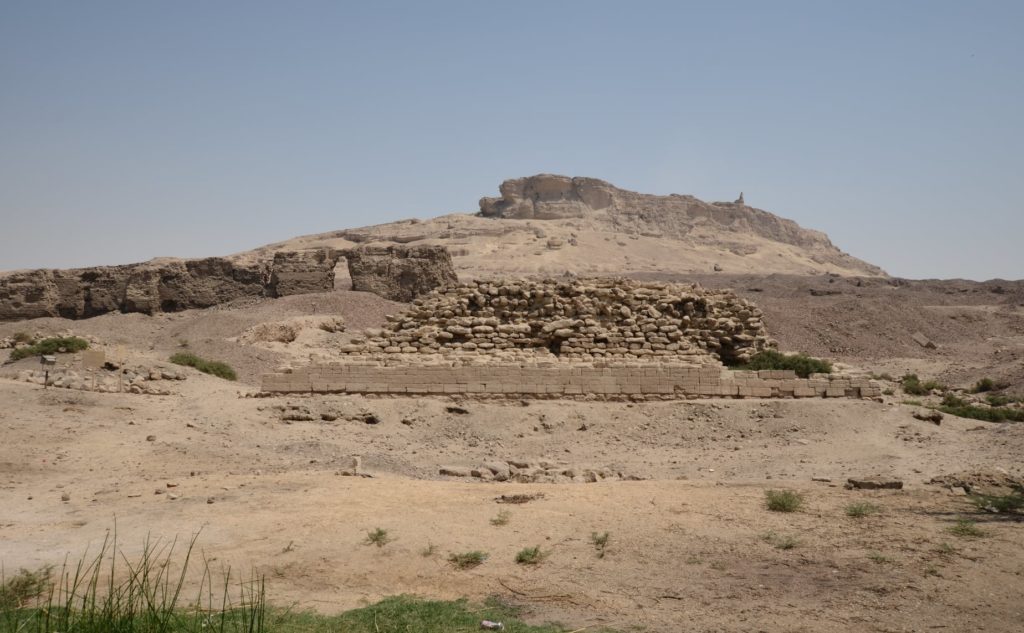
the operations of excavation have been brought to the light the principal
structures of the Roman military camp, whose construction goes up at the end
of the III century AD under the kingdom of Diocletian. About the existence
of such camp we were informed till now only by manuscript sources (Notitia
Dignitatum) and from some Greek papyrus. The Castrum of Narmuthis-Medinet
Madi was the second Roman military camp of the Fayum, over that well known
of Kasr Qarun, but till now it had not been located and discovered.
It
is a quadrangular structure with walls of great thickness, strengthened with
4 angular towers and a circular central tower; endowed with two entries, the
principal on the north side, the secondary one on the south side.
Has
been shown great part of the perimeter and about halves the lodgings of the
soldiers, destined to entertain the Cohors IV Numidarum located in Narmuthis
under the command of a Roman tribunus.
The recovery of objects is
limited to few bronze coins of the IV century AD, to modest and fragmentary
rests of ceramics of daily use and to a fragment of relief on limestone with
rest of colours, that represents the goddess Isis-Renenut in its usual form
of feminine body and the inferior part of the body of cobra, but having a
large squamous snake in relief on the chest.
The
material written, all in Greek, is constituted by an ostrakon that it brings
names of person and from some fragments of wine’s containers that they
preserve the name of the owner, certainly a soldier.
The state of maintenance
of the fortress has imposed us a big work of restoration and consolidation
of the structures of mud bricks, mainly the enormous foundations, that it
will continue together with the work of excavation in the next mission 2007.
In the second halves the
month of November, according with our application to the SCA, a work of
consolidation and restoration has been initiated in one of the houses of the
second court of the temple of Medinet Madi. Such work has been conducted in
accord with the Department of architecture and restoration of the
Inspectorate of the Fayum and bottom an inspector's control sent by the SCA.
The mission was
accompanied to Khelua and Medinet Madi by the inspector of the SCA Mazhar
Ezt El Rweesy and by the inspector of the SCA Rezk Diab Ghadiry Hassan.
Members
of the Mission:
Edda
Bresciani-Director, Rosario Pintaudi-Messina University,
Antonio
Giammarusti architect, Flora Silvano, Angiolo Menchetti.
Preliminary report, april 2007
The
archaeological Mission of the Pisa University has effected a mission during
the month of April 2007, at Medinet Madi in Fayum, in continuation with that
of October-November 2006, when happened the important discovery of the
location and exploration of a Roman fortress, the Dioclezianus’s castrum
Narmoutheos, localized in the archaeological concession of the Pisa
University thanks to the use of a satellite map with the archaeological
controls.
Till
this discovery, the two sources for the existence of a castrum at Narmouthis
in late roman epoch were the paragraph XXVIII, 46 of the Notitia Dignitatum
(known historical source compiled at the end of the IV century), and a Greek
papyrus of Theadelphia (P.Thead.4) that preserved the name of the commander
of the castrum, Flavius Salvitius, in 328 A.D.
After
this, in November 2001, the Pisa archaeological mission during the
exploration of a house to south of the temple C, found, written on a Greek
contract of guarantee dated to 326 A.D., the name of the same commander, now
with the title of tribunus.
The
only castrum of the Fayum till now recognized on archaeological site,
excavated and published (at the end of the years '40) was that of Kasr Qarun,
the ancient Dionysias, with two temples and the great fortress; the castrum
Dionysiados- so named it in the Notitia Dignitatum- is well known thanks to
the splendid Greek archives of Flavius Abinneus, commander of the Ala Quinta
Praelectorum, troops of cavalry quartered in the castrum of Kasr Qarun.
As
announced in the Report 2006, the castrum Narmoutheos, that entertained the
Cohors Quarta Numidarum, has a quadrangular structure (50 x 50 ms.) with
walls of mud bricks, thick 3,80 ms., strengthened with 4 angular towers and
a circular central tower on the west side, placed side by side with another
thick rectangular tower; it is endowed with two entries, the principal on
the North side, built with prevalence of mud bricks and stone, the second
one on the South side, toward the city, built in fired red bricks tied by
mortar. On the East side, the wall and the bastions are practically to rock
level, but are been traced in the plan.
Inside
the fortress the exploration has been continued in April 2007 in the
lodgings of the soldiers; the rooms in the zone South-West gave ceramic
material of fragmentary kegs of ellipsoidal form ( have been counted the
necks of some hundred kegs) presumably destined to contain the daily ration
of wine (measured capacity l.0,75, a tenth of the capacity of the roman
amphorae for wine in Fayum); on the most greater part of the fragments have
been found written Greek names, often accompanied by the patronymic, surely
the indication of ownership.
The
exploration of the inside lodgings of the fortress is continued, in the
West-North area, where the modern destruction has been less deep than of the
oriental South half of the camp, allowing a survey of environments with
preserved walls around the meter; it seems to be able to recognize a private
lodging, maybe for the use of the chief of the castrum; this principal room
preserves part of the original plaster and we found many fragments of the
decoration with geometric motives. This sector of the castrum didn't
directly access the zone of the cistern; but we found a singular
installation still in situ, a plumbing of tuboli
in tile along the walls of a elbow corridor, but we not have been able to
recognize from where was destined to take and to bring where the water;
perhaps a projected plan but not finished.
A
long wall, currently tall less than a meter but that, calculating the height
of the level on base the adjacent vault of the cistern, had to present
himself with a height of around m. 1,70; using the comparison with Kasr
Qarun, we can propose that on the raised base or bema;
on the axle of the door North, existed the “chapel of the insignias”,
flanked by two rooms.
The
most important discovery of this mission is certainly that of a complex
hydraulic system and till now without parallel, certainly worthy example of
the hydraulic engineering of the Romans.
It
is a square cistern (side: m. 3,35) inside the castrum, immediately after
the entrance South, cut in the rock, and entirely covered by a vault in
fired bricks. The vault has been found not whole, probably broken down by
the fall of a great capital Corinthian for pillar (found collapsed inside
the cistern).
The
capital presumably originates from the colonnade that departed from the door
North (on the
model
of Kasr Qarun) or maybe from the architectural structure of the chapel, as
also two bases and columns found under the level between sand and collapses
of wall in the room KMM South 3.
The
destruction and the spoil of the castrum was performed, can be hypothesized,
in the epoch of the to bloom of churches in Medinet Madi, and has been
completed by the devastations of the sebbakhins.
The
findings of objects in April 2007 consist in ceramics, some Greek Ostraka,
few bronze coins very oxidize, and in a bronze bracelet, of Christian epoch
adorned with a monogram of Christ.
Also
during the mission of April 2007 has been devoted great care, time and money
for the protection and the maintenance particularly of the hydraulic
installations.
The mission,
formed by E.Bresciani, R. Pintaudi- Messina University, Angiolo Menchetti,
the architect Antonio Giammarusti, was accompanied by the Inspector of the
SCA Mohammed Badr el Din Hassan, who has been of great help and good
collaboration.
Prof.
Edda Bresciani Director of the Mission
Medinet
Madi October 2006-April 2007
Preliminary
Report November 2007 The
archaeological Mission of the Pisa University -
with Prof. Rosary Pintaudi, Messina University
has
effected a mission during the month of November 2007, in the archaeological
concession of the Pisa University at Medinet Madi in Fayum, in continuation
with that of April 2007.
Inside
the fortress has been continued the exploration in the lodgings of the
soldiers, in the South half of the camp and the West-North area. The long
wall, is confirmed as the raised base or bema; on the axle of the door North, existed the “Chapel” for
the imperial cult, flanked by two rooms; the colonnade that departed from
the door North (on the model of Kasr Qarun) arrived near the long wall, and
the raised zone of bema was reached by 4-5 steps.
Outside
of the castrum, in the north zone, has been discovered a “forno”, maybe
industrial maybe for alimentary aims.
In
April 2007 had been discovered inside the castrum a complex hydraulic
system
and
till now without parallel, certainly worthy example of the hydraulic
engineering of the Romans, a square cistern (side: m. 3,35) inside the
castrum cut in the rock, and entirely covered by a vault in fired bricks.
But
it was necessary continue the control of the system of the adduction and
derivation channels; during November 2007 expedition this has been obtained
with trenches till the actual fields, under which the old channel continues.The
old agricultural channel, oriented South-North, gave water to the castrum’s
cistern with a system of two tubs related by channel; an other water point
present eleven steps to reach the cut- rock channel.
The
place of two old saqyia is to recognize in the South section of the channel.
This section of research (to be continue during next seasons) has been
studied – for publication- in the exploration November 2007 by Emenuele
Brienza.
It
is clear that the explorations of this year show how it is necessary the
control of the still existing areas around
the archaeological sites, to avoid that the new cultivations could destroy
the rests of ancient civilisation. We could call this interventions of our
archaeological missions with the definition of “urgency
excavations”.Also
during the mission of November 2007 has been devoted great care, time and
money for the protection and the maintenance of the big walls of the castrum
and of the inner installations and the channel line with the important water
points.
The
Pisa University mission, formed by E.Bresciani, R. Pintaudi, Flora Silvano,
Angiolo Menchetti, Antonio Giammarusti architect and the archaeologist and
topographer Emanuele Brienza- Rome University, was accompanied by the
Inspector of the SCA Mohammed Hamed Mohammed Ahmed, who has been of great
help and good collaboration.
Next
season of work: March-April 2008.
Prof.
Edda Bresciani Director of the Mission
Medinet
Madi 26 November 2007 |